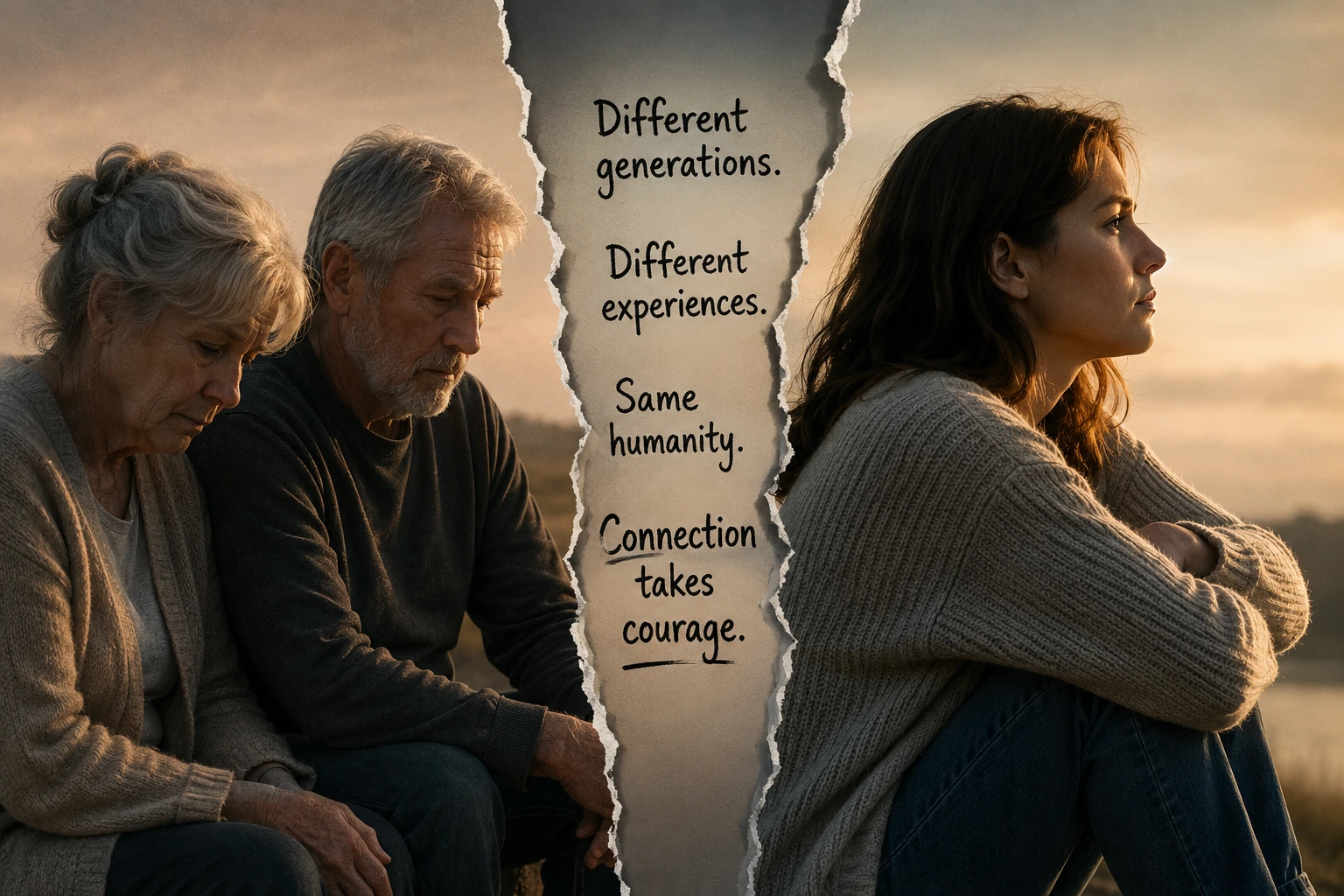
Much has been written about childhood wounds, toxic parenting and the lifelong impact of adverse experiences. Those conversations matter. Many people carry genuine emotional scars that deserve compassion, understanding and, where needed, professional support.
But there is another side to family relationships that receives far less attention.
Sometimes, loving parents become the ones quietly carrying emotional pain.
Not because they were perfect—they weren’t. No parent is. But because, somewhere along the journey from childhood to adulthood, the relationship became defined entirely by blame rather than understanding.
As a counsellor, I believe healing requires us to hold two truths at once:
Parents can make mistakes that leave lasting wounds.
And adult children can unintentionally wound their parents too.
Healthy family relationships depend upon both generations being willing to reflect, grow and accept responsibility.
1. Seeing your entire childhood through the lens of parental failure
It is understandable to explore how childhood has shaped us. Our earliest relationships influence our beliefs, confidence and emotional wellbeing.
However, problems arise when every struggle in adult life is traced back exclusively to our parents.
Anxiety becomes Mum’s fault.
Relationship difficulties become Dad’s fault.
Low confidence, poor choices or emotional struggles are all explained by childhood alone.
Life is rarely that simple.
Most parents raised children while juggling financial pressures, demanding jobs, relationship difficulties, illness, grief and often their own unresolved childhood experiences.
They didn’t parent with the benefit of hindsight.
They parented with the knowledge, resources and emotional capacity they had at the time.
When decades of love, sacrifice and commitment are reduced to a catalogue of mistakes, many parents are left grieving the feeling that nothing they did ever truly mattered.
2. Using psychological language to end conversations rather than deepen them
Therapy has given us valuable language to understand ourselves.
Terms such as boundaries, gaslighting, trauma, narcissism and emotional abuse have helped countless people make sense of painful experiences.
Yet these words can also become labels rather than invitations to understanding.
A disappointed parent becomes “emotionally manipulative.”
Concern becomes “controlling.”
Disagreement becomes “toxic.”
Suddenly every emotional response is interpreted as evidence of dysfunction.
The irony is that therapy should improve communication—not close it down.
Real emotional maturity involves curiosity before judgement.
Sometimes a parent is genuinely manipulative.
Sometimes they are simply hurt.
Learning the difference is essential if families are ever to reconnect.
3. Expecting lifelong support without offering it in return
Parenting is naturally one-sided while children are young.
But adulthood changes the relationship.
Healthy adult relationships are built upon reciprocity.
Many parents continue to provide emotional support, childcare, financial help, practical assistance and endless reassurance long after their children have left home.
Yet they quietly wonder:
“Who asks how I’m coping?”
“Who notices that I’m growing older?”
“Who checks whether I need support?”
Parents do not stop being human simply because their children become adults.
They still experience loneliness.
Illness.
Bereavement.
Financial worries.
And they still need to feel loved—not simply useful.
4. Using grandchildren as leverage
There are circumstances where limiting contact is necessary to protect children.
But when access to grandchildren becomes a bargaining tool during disagreements, everyone loses.
Grandparents lose precious memories they can never recover.
Children lose loving relationships.
Parents feel powerless and emotionally blackmailed.
Relationships built on fear rarely become healthy.
Children also absorb an important message:
Love is conditional.
Family is something that can be withdrawn as punishment.
That lesson often echoes into the next generation.
5. Dismissing life experience because it belongs to another generation
Every generation believes life has changed dramatically.
And it has.
Technology evolves.
Society changes.
Culture shifts.
Yet some human experiences remain remarkably consistent.
Loss.
Love.
Heartbreak.
Financial pressure.
Parenthood.
Grief.
Resilience.
Parents may not understand every aspect of modern life, but many have walked roads their adult children are only beginning to travel.
Automatically dismissing their wisdom because it feels “old-fashioned” can leave them feeling invisible.
Experience may look different across generations.
Its value does not disappear.
6. Blaming your parents for every difficulty in adult life
Our childhood shapes us.
It does not define us forever.
Acknowledging painful experiences is an important part of healing.
Remaining permanently trapped within them is something different.
There comes a point where healing asks a difficult question:
“What do I want my future to look like?”
Taking responsibility for our present is not the same as excusing our past.
Both things can exist together.
Parents should be accountable for genuine harm.
Adult children also deserve the freedom that comes from recognising their own agency.
Healing begins where blame ends.
7. Confusing healthy boundaries with punishment
Healthy boundaries protect relationships.
Punishment destroys them.
There are circumstances where low contact—or even no contact—is the healthiest choice, particularly where abuse, coercive control or ongoing emotional harm exists.
But increasingly, some family relationships fracture over conflicts that might once have been repaired through honest conversation.
Boundaries should create emotional safety.
They should not become instruments of revenge.
A healthy boundary leaves room for growth, accountability and reconciliation where it is safe to do so.
Punishment seeks suffering.
There is an important difference.
8. Never allowing parents to outgrow their worst mistakes
None of us wants to be permanently judged by the worst version of ourselves.
Yet this is precisely how some parents experience later life.
Every disagreement resurrects mistakes made twenty or thirty years ago.
Every conversation returns to childhood.
Growth goes unnoticed.
Apologies are forgotten.
Change is ignored.
People evolve across decades.
If we refuse to acknowledge that possibility, relationships become trapped in history rather than allowed to develop in the present.
9. Comparing parents with ideal families
Social media has created impossible standards of parenting.
Perfect Christmases.
Perfect childhoods.
Perfect communication.
Perfect emotional awareness.
Real families are rarely perfect.
Many parents raised children while managing financial hardship, mental health challenges, undiagnosed neurodiversity, caring responsibilities or difficult marriages.
Comparison often overlooks context.
Most parents were simply trying to get through each day while loving their children as best they knew how.
Perfection was never an option.
Doing their best often was.
A Final Reflection
This isn’t an argument against therapy.
Nor is it a defence of poor parenting.
Some parents are abusive.
Some family relationships require firm boundaries or even permanent distance.
Those realities should never be minimised.
But many families exist in the vast middle ground.
Not abusive.
Not perfect.
Simply human.
Healing family relationships requires compassion flowing in both directions.
Parents benefit from acknowledging where they caused pain.
Adult children benefit from recognising the sacrifices, love and imperfections that exist alongside those painful memories.
The strongest relationships are rarely those where one person is entirely right and the other entirely wrong.
They are built when both generations become willing to replace blame with curiosity, certainty with compassion and judgement with understanding.
Because family healing is rarely about deciding who was the villain.
More often, it begins when everyone has the courage to become more fully human.